Quick Overview
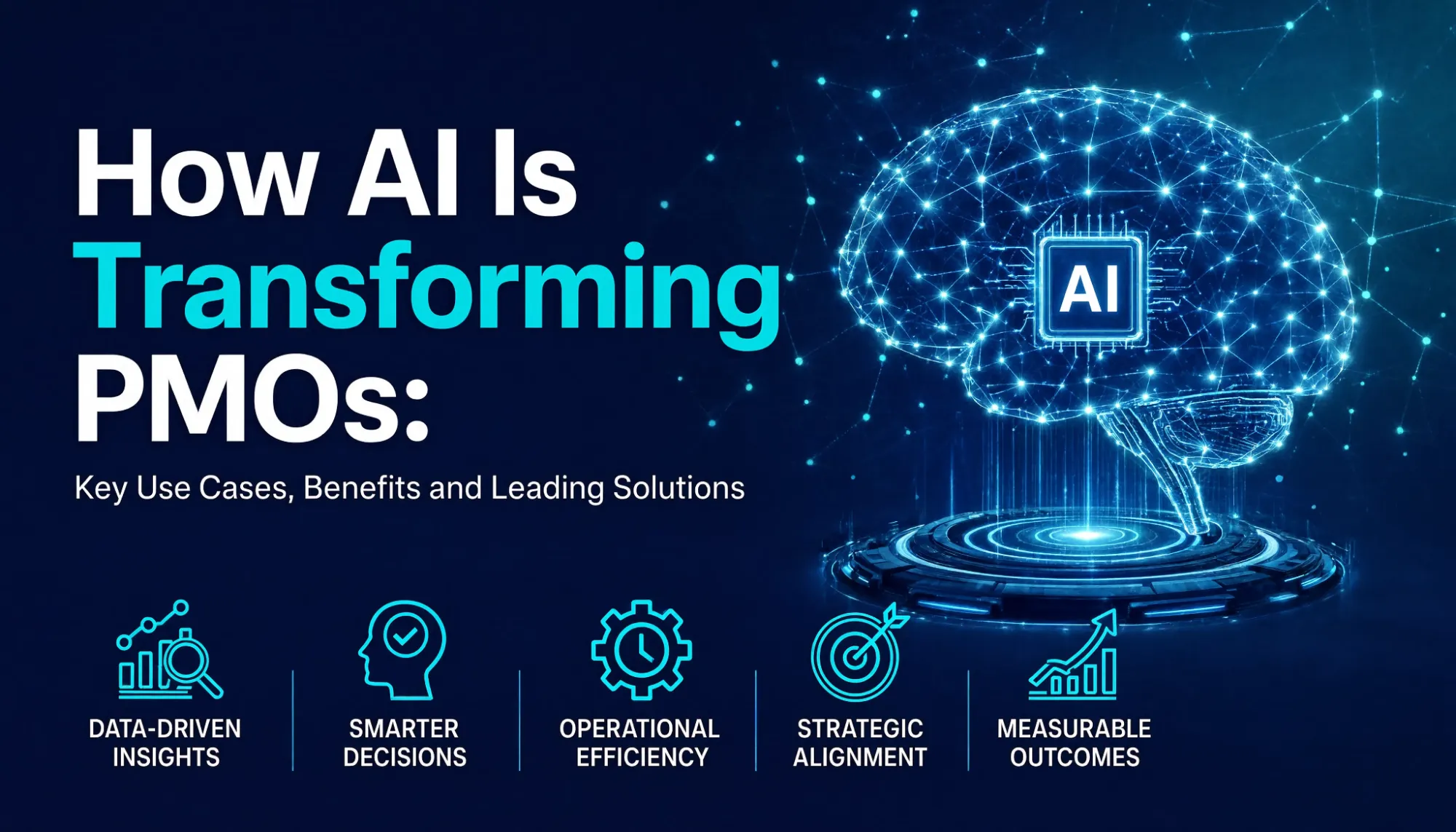
AI is transforming the modern Project Management Office (PMO) by helping organizations reduce administrative work, identify project risks earlier, improve resource planning, and make more informed portfolio decisions. From automated reporting and meeting summaries to predictive analytics and AI agents, emerging technologies are changing how PMOs support strategy and execution.
This blog explores AI use cases for PMOs, leading AI solutions and the importance of AI governance, human oversight, and responsible automation. It also outlines a practical approach for building an AI-ready PMO and explains how organizations can integrate AI with their people, processes, data, and governance structures.
In this blog, discover how AI can help PMOs move from traditional reporting toward proactive, data-driven decision support while maintaining governance and accountability.
Project Management Offices are undergoing a significant shift. Traditionally responsible for governance, reporting, methodology, risk oversight, and portfolio coordination, PMOs are increasingly expected to provide real-time intelligence that helps executives make better decisions.
Artificial intelligence is becoming an important part of this transformation.
From automatically generating project reports to identifying potential delivery risks, AI can reduce administrative workloads and help PMO professionals focus on higher-value activities. Leading platforms such as Microsoft Planner, ServiceNow, Atlassian Jira, Planview, Smartsheet, and Asana are already incorporating AI into project and portfolio management workflows.
The opportunity, however, extends beyond adopting an AI-enabled project management platform. Organizations need to determine how AI fits into their broader operating model, governance structure, data environment, and strategic objectives.
Why AI Matters for the Modern PMO
PMOs frequently operate at the intersection of strategy and execution. They must translate organizational priorities into programs, monitor delivery, manage dependencies, provide leadership visibility, and identify issues before they become major business problems.
Yet much of the information required for these activities is fragmented across project management systems, spreadsheets, emails, meeting notes, documents, and collaboration platforms.
AI can help bring this information together and turn large volumes of project data into actionable insights.
For example, an AI-enabled PMO can help answer questions such as:
- Which projects are most likely to experience delays?
- Where are resource constraints emerging?
- Which initiatives are exceeding expected costs?
- Which projects have unresolved dependencies?
- Are current initiatives aligned with strategic priorities?
- Which risks require immediate management attention?
This moves the PMO from retrospective reporting toward more proactive decision support.
Five Major AI Use Cases for PMOs
1. Automated Project Reporting
Reporting is one of the most time-consuming PMO activities.
Project managers may spend hours collecting updates, reviewing task information, writing status reports, and preparing executive presentations.
AI can summarize project information and generate initial reports based on current project data. Microsoft Planner’s Copilot capabilities, for example, can help generate plans, goals, tasks, and status reports.
The PMO professional remains responsible for validating the information, but AI can significantly reduce the effort required to produce the first version.
2. Early Risk Identification
AI can analyze project information to identify patterns that may indicate emerging risks.
These could include:
- Repeated milestone slippage
- Increasing numbers of overdue tasks
- Resource overload
- Unresolved dependencies
- Budget deviations
- Changes in project scope
- Declining project health indicators
ServiceNow’s Strategic Portfolio Management capabilities demonstrate this direction by using AI to assist with project health analysis, summaries, status reporting, and risk identification.
The value is not that AI makes the risk decision. Its value is that it can help PMO teams identify where human investigation is needed.
3. Resource and Capacity Planning
Resource allocation becomes increasingly difficult as organizations manage multiple projects simultaneously.
AI-enabled portfolio management can analyze demand, capacity, project priorities, skills, and workloads to identify potential resource conflicts.
Planview, for example, positions AI-powered portfolio management around prioritization and resource-related decision support.
For enterprise PMOs, this can help leadership understand the consequences of adding a new initiative or changing the priority of an existing one.
4. Meeting and Knowledge Management
Project teams generate enormous amounts of information through meetings, documents, emails, and collaboration platforms.
AI can summarize meetings, identify decisions, extract action items, and make project knowledge easier to retrieve.
This is especially valuable when stakeholders need information quickly but do not have time to review hundreds of pages of project documentation.
An AI-enabled knowledge layer can allow stakeholders to ask questions in natural language rather than searching through multiple systems manually.
5. Portfolio Prioritization
One of the most strategic applications of AI is helping organizations decide which initiatives deserve investment.
A PMO may be responsible for dozens or hundreds of initiatives competing for limited funding and resources.
AI can help analyze factors such as:
- Strategic alignment
- Expected business value
- Risk
- Cost
- Resource requirements
- Dependencies
- Delivery probability
The final decision should remain with accountable business leaders, but AI can improve the quality and speed of the analysis supporting those decisions.
Leading AI Solutions for PMOs
The AI market for project management is evolving rapidly, but several enterprise platforms demonstrate where adoption is heading.
Microsoft Planner and Copilot integrate AI into Microsoft’s productivity ecosystem, helping users create plans, tasks, goals, and project updates.
ServiceNow Strategic Portfolio Management incorporates AI into portfolio and project workflows, including project health analysis, reporting, and AI agents.
Atlassian Jira and Rovo bring AI into software development and Agile environments, where project information is closely connected to tickets, documentation, and development workflows.
Planview applies AI to portfolio management, prioritization, resource planning, and strategic alignment.
Smartsheet uses AI across project data and workflow automation, while Asana AI provides capabilities for project summaries, status updates, project questions, and workflow support.
The important trend is that AI is increasingly embedded within the systems where work already happens.
What AI Means for PMO Consulting
Organizations should not begin with the question, “Which AI tool should we buy?”
A stronger starting point is:
Where can AI improve PMO performance without compromising governance, security, or accountability?
This requires an assessment of the organization’s current PMO operating model, technology environment, data quality, workflows, and strategic objectives.
For organizations seeking PMO Consulting Services, AI readiness should therefore become part of the PMO transformation discussion.
An effective assessment can identify:
- High-volume manual processes
- Repetitive reporting activities
- Data sources that can support AI analysis
- Opportunities for workflow automation
- Areas where predictive analytics can add value
- Governance requirements
- Human decisions that should remain under accountable leadership
This creates a practical roadmap rather than an AI implementation driven primarily by technology enthusiasm.
AI Governance Is Essential
AI introduces new risks alongside its potential benefits.
Project information can contain confidential financial data, customer information, strategic plans, intellectual property, and sensitive operational information.
PMOs therefore need clear policies governing how AI systems access, process, store, and generate information.
NIST’s AI Risk Management Framework and its Generative AI Profile provide organizations with a structured approach for identifying and managing AI-related risks.
For PMOs, governance should address data access, privacy, security, human oversight, output validation, auditability, vendor risk, and accountability.
This is especially important as organizations move from simple AI assistants toward more autonomous AI agents.
From AI Assistants to AI Agents
The next phase of PMO transformation may involve AI agents capable of monitoring project environments and performing defined actions.
Instead of waiting for a project manager to request a report, an AI agent could monitor project conditions and identify exceptions.
For example, a governed workflow might allow an AI agent to:
- Monitor milestone changes
- Identify overdue activities
- Prepare a risk summary
- Notify an appropriate stakeholder
- Draft a status report
- Recommend corrective actions
Human oversight remains essential, particularly when decisions affect budgets, contracts, staffing, customers, or strategic priorities.
The goal should be controlled autonomy not uncontrolled automation.
Building an AI-Ready PMO
Organizations can approach AI adoption in stages.
Stage 1: Assess. Identify repetitive work, data sources, pain points, and governance requirements.
Stage 2: Augment. Introduce AI for reporting, summarization, research, documentation, and knowledge retrieval.
Stage 3: Automate. Connect AI to workflows where rules and controls can be clearly defined.
Stage 4: Analyze. Introduce predictive capabilities for risks, resources, schedules, and portfolio decisions.
Stage 5: Scale. Establish enterprise-wide AI governance and expand successful use cases across the PMO.
This approach allows organizations to demonstrate value while building the capabilities needed for responsible AI adoption.
The Strategic Future of the PMO
AI will not eliminate the need for PMO professionals. Instead, it has the potential to change where their time and expertise are concentrated.
Less time can be spent collecting information and producing repetitive reports. More time can be dedicated to strategic alignment, stakeholder management, risk decisions, organizational change, and resolving complex delivery challenges.
That makes AI an opportunity to strengthen the strategic role of the PMO.
For organizations exploring AI Strategy Consulting, the objective should therefore be broader than implementing individual AI tools. It should be about creating an operating model in which AI, people, processes, data, and governance work together.
How Intellecomm Can Help
Intellecomm helps organizations connect technology transformation, AI strategy, automation, and PMO capabilities to practical business outcomes.
An AI-enabled PMO requires more than software. It requires an understanding of business processes, governance, organizational priorities, data, risk, and change management.
Through AI Strategy Consulting and AI Automation Consulting Services, organizations can identify high-value opportunities for intelligent automation while establishing the governance and operating structures needed to scale AI responsibly.
The future PMO is not simply a technology-enabled PMO. It is a more intelligent, data-driven, and strategically focused function one where AI handles appropriate repetitive work while experienced professionals remain accountable for critical decisions.