Overview:
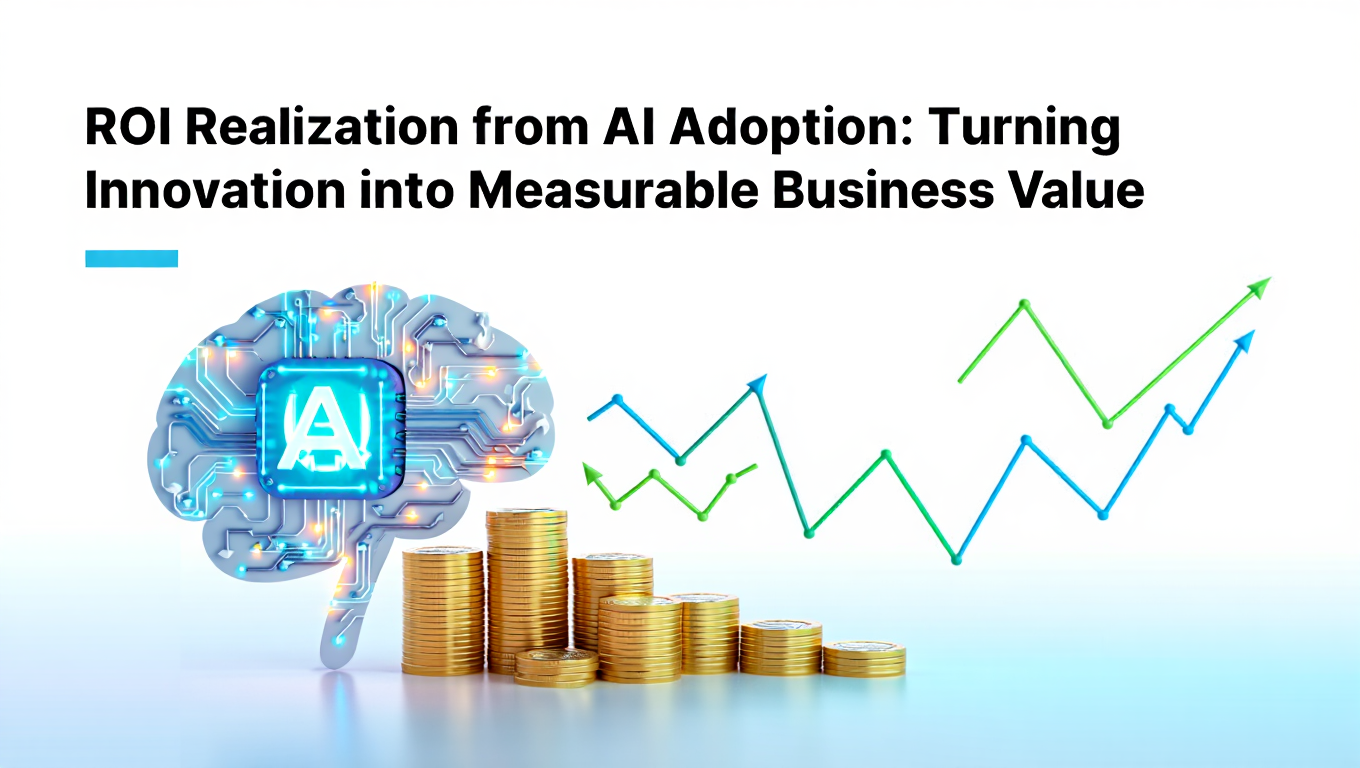
This blog explores how businesses can turn AI adoption into measurable return on investment (ROI). While many organizations are investing in AI technologies, achieving real value requires more than just implementation; it demands a strategic approach. This article highlights the importance of aligning AI initiatives with clear business objectives, prioritizing high-impact use cases, and ensuring strong data quality and security.
It also emphasizes integrating AI into existing workflows, tracking meaningful performance metrics, and building internal capabilities to support long-term success. Additionally, the blog outlines the need for gradual scaling, continuous optimization, and strong governance to sustain ROI.
Overall, the content provides a practical roadmap for organizations to move beyond experimentation and successfully realize tangible business value from AI investments.
Artificial Intelligence (AI) has quickly moved from a buzzword to a business imperative. Across industries, companies are investing heavily in AI-driven tools, automation platforms, and data intelligence systems. Yet one question continues to surface in boardrooms and strategy meetings:
Are we actually seeing a return on our AI investments?
While adoption is accelerating, ROI realization from AI is not always immediate or obvious. Many organizations implement AI solutions expecting rapid transformation, only to find that results take time, alignment, and the right strategy to materialize.
The truth is, AI doesn’t automatically deliver value. It’s how businesses integrate, manage, and scale it that determines success. This article explores how organizations can move beyond experimentation and start realizing measurable ROI from AI adoption in a practical, sustainable way.
Understanding ROI in the Context of AI
ROI from AI is different from traditional technology investments. It’s not just about cost savings; it’s about enhanced decision-making, improved customer experiences, and new revenue opportunities.
Some of the most common areas where businesses see ROI include:
- Process automation and efficiency gains
- Reduction in operational costs
- Faster and more accurate decision-making
- Improved customer engagement
- Revenue growth through personalization
1. Start with Clear Business Objectives, Not Just Technology
One of the biggest reasons AI initiatives fail to deliver ROI is a lack of clarity around goals.
Organizations often begin with questions like:
- “What AI tools should we use?”
- “Which platform is the best?”
Instead, the focus should be:
- “What problem are we solving?”
- “What measurable outcome do we want?”
High-performing companies start by identifying specific use cases such as reducing customer churn, improving forecasting accuracy, or automating repetitive workflows.
This approach ensures that AI investments are directly tied to business outcomes, making ROI easier to measure and justify.
2. Prioritize High-Impact Use Cases
Not all AI applications deliver equal value. Some projects may look impressive but offer limited business impact.
To maximize ROI, organizations should prioritize:
- Use cases with clear financial benefits
- Processes with high volume and repetition
- Areas where human error is costly
For example:
- Automating customer support responses
- Predictive maintenance in manufacturing
- Fraud detection in financial services
By focusing on high-impact areas first, businesses can generate quick wins that build momentum and confidence in AI adoption.
3. Data Quality Matters More Than Algorithms
There’s a common misconception that AI success depends primarily on advanced algorithms. In reality, data quality plays a far bigger role.
Poor or inconsistent data leads to inaccurate insights, which ultimately undermines ROI.
Organizations that succeed with AI invest in:
- Clean, structured, and accessible data
- Strong data governance practices
- Integration across systems and platforms
Without a solid data foundation, even the most sophisticated AI models will struggle to deliver meaningful results.
4. Integrate AI into Existing Workflows
AI delivers the most value when it becomes part of everyday business operations, not when it exists as a standalone initiative.
Many organizations make the mistake of treating AI as a separate project, disconnected from core workflows. This often leads to low adoption and limited ROI.
Instead, businesses should focus on:
- Embedding AI into existing systems
- Aligning AI outputs with decision-making processes
- Ensuring teams understand how to use AI insights
For example, a sales team is more likely to benefit from AI if predictive insights are integrated directly into their CRM, rather than presented in a separate dashboard.
5. Measure What Actually Matters
ROI realization requires clear and consistent measurement. However, many organizations struggle to define the right metrics.
Rather than focusing only on technical performance (like model accuracy), businesses should track:
- Cost savings achieved
- Time saved through automation
- Revenue growth linked to AI initiatives
- Customer satisfaction improvements
- Employee productivity gains
These metrics provide a more complete picture of how AI is contributing to business outcomes.
6. Build Internal Capabilities Alongside Technology
AI adoption is not just a technology upgrade it’s an organizational transformation.
Companies that see strong ROI invest in:
- Upskilling employees
- Building cross-functional teams
- Encouraging a data-driven culture
When employees understand how to work with AI tools, adoption increases, and the value of those tools grows significantly.
In some cases, businesses also collaborate with experts offering Artificial Intelligence Consulting Services to accelerate learning and implementation, especially during the early stages of adoption.
7. Scale Gradually, Not All at Once
A common mistake organizations make is trying to scale AI too quickly.
Large-scale implementations without proper testing often lead to:
- Operational disruptions
- Increased costs
- Unclear results
A more effective approach is to:
- Start with pilot projects
- Validate results
- Refine models and processes
- Scale gradually across the organization
This phased approach reduces risk and ensures that each step delivers measurable value before expanding further.
8. Align AI with Business Strategy
AI should never operate in isolation. It needs to align with the broader business strategy to deliver meaningful ROI.
This includes:
- Supporting long-term growth objectives
- Enhancing competitive advantage
- Addressing key business challenges
Organizations that take a strategic approach often supported by AI Strategy Consulting are better positioned to ensure that AI investments contribute directly to business success rather than becoming isolated experiments.
9. Focus on Automation That Frees Up Human Potential
One of the most immediate sources of ROI from AI comes from automation. However, the goal shouldn’t just be to replace tasks it should be to enhance human productivity.
AI-powered automation can:
- Eliminate repetitive tasks
- Reduce manual errors
- Free up time for higher-value work
For example:
- Automating data entry allows employees to focus on analysis
- Streamlining workflows improves overall efficiency
Organizations that leverage AI Automation Consulting Services often discover that the biggest gains come from enabling their teams to work smarter, not harder.
10. Continuously Optimize and Improve
AI is not a “set it and forget it” solution. Models need to be monitored, updated, and refined over time.
Continuous optimization ensures:
- Improved accuracy
- Better performance
- Sustained ROI
Businesses should regularly:
- Review performance metrics
- Update data inputs
- Adjust models based on changing conditions
Working with an experienced AI and Automation Consultant can help organizations maintain and enhance their AI systems as they evolve.
11. Enterprise-Level Adoption Requires Strong Governance
As AI adoption scales, governance becomes increasingly important.
Large organizations, in particular, must address:
- Data privacy and security
- Ethical considerations
- Regulatory compliance
This is where Enterprise AI Consulting can play a role in establishing frameworks that ensure responsible and scalable AI adoption.
Strong governance not only reduces risk but also builds trust both internally and externally, which is essential for long-term ROI.
Common Challenges in Realizing AI ROI
Despite the potential, many organizations face challenges such as:
- Lack of clear strategy
- Poor data quality
- Limited internal expertise
- Resistance to change
- Difficulty measuring impact
Recognizing these challenges early allows businesses to address them proactively and improve their chances of success.
What Successful AI Adoption Looks Like
Organizations that successfully realize ROI from AI tend to share a few common traits:
- They start with clear business goals
- They prioritize high-impact use cases
- They invest in data and people not just technology
- They scale gradually and strategically
- They continuously measure and optimize
Most importantly, they view AI as a long-term capability rather than a short-term solution.
FAQs
Final Thoughts
AI adoption is no longer optional for businesses looking to stay competitive. However, the real value of AI lies not in the technology itself, but in how it is applied.
ROI realization requires a thoughtful approach, one that combines strategy, execution, and continuous improvement.
By focusing on meaningful use cases, aligning AI with business objectives, and building the right internal capabilities, organizations can move beyond experimentation and start seeing measurable, lasting results.
In the end, AI is not just about innovation; it is about its impact. And when implemented effectively, that impact can transform the way businesses operate, compete, and grow.