Quick Overview
AI is moving quickly from experimentation into enterprise-scale deployment. Most organizations are focused on models, tools, and platforms, but in practice, those are not the limiting factors. The real constraint is whether the organization has built a foundation of trusted data and embedded security.
At scale, AI does not fail because it is not intelligent enough. It fails because the environment it operates in is not reliable enough. If data is inconsistent or poorly governed, and if security is bolted on after the fact, AI simply amplifies those weaknesses.
This paper explores why data and security are not supporting capabilities in AI, but the actual foundation on which everything else depends, particularly in regulated industries such as financial services.
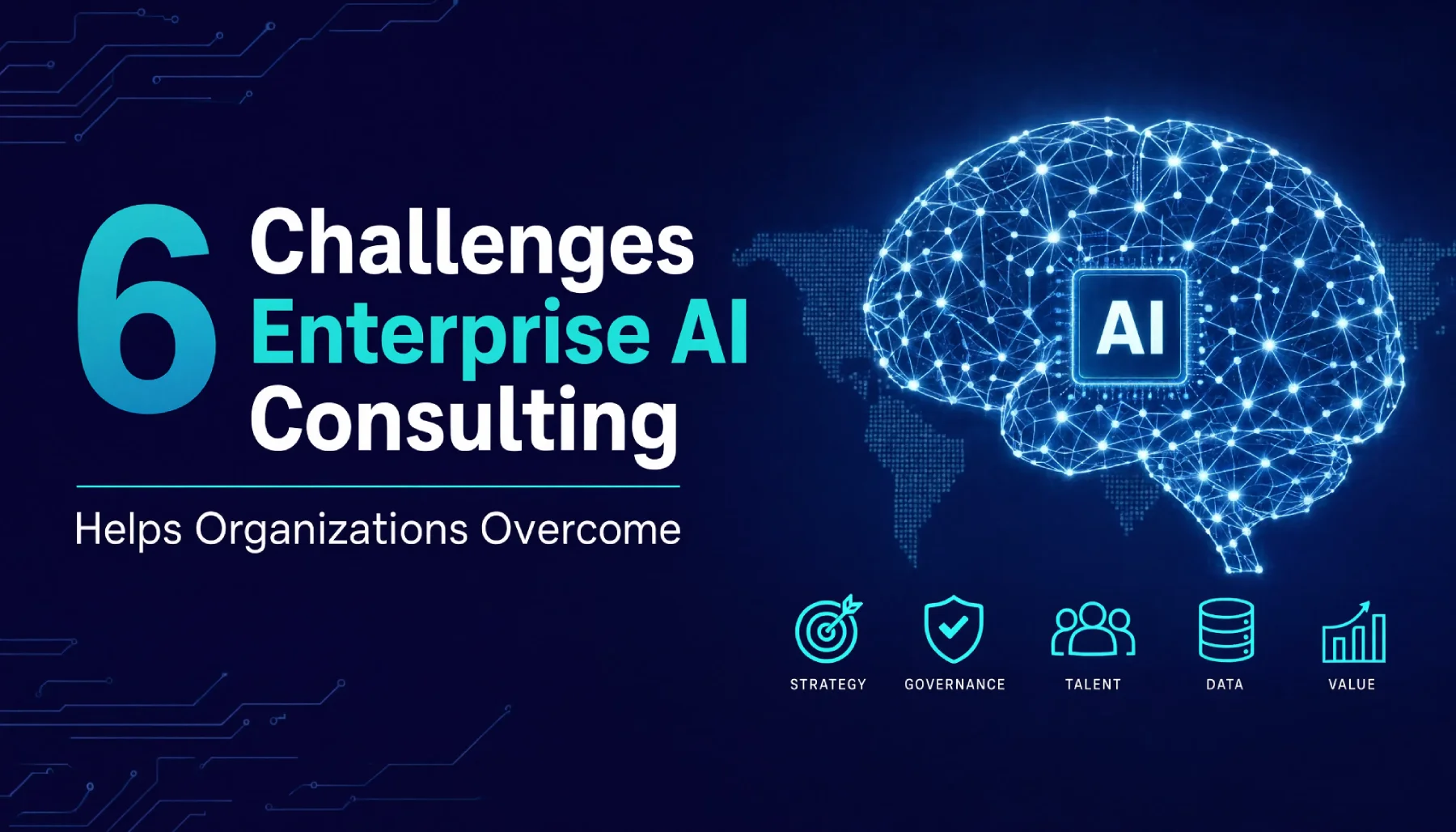
Organizations increasingly turn to Enterprise AI Consulting partners to help establish this foundation before scaling AI initiatives.
AI at Scale Is a Trust Problem, Not Just a Technology Problem
Much of the current AI conversation focuses on models, especially large language models and generative systems. While those capabilities are important, they are only one layer of the system.
When organizations attempt to scale AI across business units, the challenges rarely come from the model itself. Instead, they emerge from fragmented data environments, unclear ownership of information, inconsistent governance practices, and security models that were never designed for AI-driven access patterns.
In other words, the question shifts from “Can we build the model?” to “Can we trust the data, the controls, and the environment the model depends on?”
Data as the Core Engine of AI
AI systems do not create intelligence in isolation. They amplify patterns that already exist in the data they are trained on or retrieve from.
When that data is incomplete, inconsistent, or poorly defined, the outputs reflect those weaknesses at scale. The impact is not linear it compounds as AI systems are embedded into more processes and decision flows.
For AI to be reliable in production, data must be accurate, complete, timely, consistent, and meaningful in context. These are not abstract data management ideals; they are operational requirements for any system that is expected to make or support decisions.
At scale, this requires a shift in how organizations think about data architecture. It is no longer sufficient to simply store information in repositories. Data must be connected, traceable, and governed in a way that allows it to move safely and predictably across the enterprise.
This is where an experienced AI and Automation Consultant can help align data pipelines with scalable AI use cases.
Security in the Age of AI
AI changes the security landscape in a fundamental way because it changes how data is accessed and used. Systems that were previously isolated or tightly controlled are now being exposed to broader, more dynamic access patterns driven by AI workloads.
This creates new categories of risk. Sensitive data can be unintentionally exposed through poorly governed AI pipelines. Attack surfaces expand because AI systems interact with more data, more users, and more external services than traditional applications.
At the same time, entirely new forms of attack have emerged. AI systems can be manipulated through carefully crafted inputs, poisoned through corrupted training data, or reverse-engineered to extract sensitive information.
These are not theoretical concerns. They represent a shift in the security model from protecting static systems to protecting dynamic, learning systems that evolve over time.
Why Data and Security Can No Longer Be Separated
In many organizations, data management and cybersecurity have traditionally been treated as separate disciplines. AI forces a convergence of these domains.
Data cannot be considered trustworthy unless it is also secure. Security cannot be effective unless it understands how data is structured, accessed, and used within AI systems.
A modern AI environment, therefore, depends on a trusted data foundation where lineage is visible and governance is consistent, combined with a security layer that is designed specifically for AI workloads. This includes strong identity controls, encryption across all states of data, and continuous monitoring of how AI systems behave in production.
Just as importantly, governance can no longer be an afterthought. It must be embedded directly into the flow of data and model operations so that controls are enforced automatically rather than manually applied.
A Practical Way to Understand AI at Scale
Although AI systems can appear complex, most successful enterprise implementations follow a relatively simple structure.
At the base is the data foundation, where information is curated, governed, and made available in a consistent way across the organization. On top of that sits a security and trust layer, which ensures that only the right data is accessed by the right systems under the right conditions. The final layer is the intelligence layer, where models, agents, and applications operate on top of this foundation.
When these layers are aligned, AI becomes stable and scalable. When they are not, organizations tend to experience fragmented pilots, inconsistent outputs, and increasing operational risk.
Why AI Programs Fail in Practice
Most AI initiatives do not fail because the models are ineffective. They fail because the foundations are incomplete.
A common pattern is that organizations begin building AI solutions on top of data that is not fully governed or understood. Over time, this creates inconsistencies in outputs that are difficult to trace back to their source.
In other cases, security is introduced late in the lifecycle, after models are already in production. This leads to retrofitted controls that are difficult to maintain and often insufficient for the level of risk exposure involved.
Another frequent challenge is misalignment between the teams responsible for data, security, and AI. Without shared accountability, governance becomes fragmented and inconsistent.
What Leadership Needs to Do Differently
For executive teams, the shift required is not purely technical. It is structural.
Data must be treated as a core enterprise asset rather than a by-product of systems. Security must be designed into AI systems from the outset rather than applied after deployment. Governance must be coordinated across CIO, CISO, and data leadership functions rather than managed in isolation.
This is often supported through structured AI Strategy Consulting, helping organizations align business goals with scalable AI governance models.
Ultimately, the maturity of AI within an organization reflects something deeper: the maturity of how that organization manages trust.
CIO and CISO Playbook for Financial Services
In financial services, these challenges are amplified by regulation, systemic risk considerations, and heightened expectations around transparency and accountability.
The CIO’s role is to ensure that the underlying data and technology environment can actually support AI at scale. This involves modernizing data architectures toward cloud-native or hybrid lakehouse models, ensuring that data is available in near real time for critical use cases such as fraud detection and risk analysis, and standardizing how AI and machine learning systems are developed and deployed across the organization. It also requires strong data governance, including clear lineage and classification, as well as alignment with regulatory expectations.
The CISO’s role is to ensure that as AI expands the use of data, it does not expand risk beyond acceptable boundaries. This means designing security models that account for AI-specific threats such as prompt injection and data poisoning, implementing zero trust principles across both human users and machine agents, and ensuring that encryption and privacy protections are consistently applied. It also requires extending monitoring capabilities beyond traditional infrastructure into AI behavior itself, including how models respond and evolve over time.
Where this becomes most important is in how these roles work together. AI at scale requires a shared governance model where CIO and CISO functions are aligned rather than separate. In practice, this often means joint governance structures for AI use cases, unified risk frameworks that combine cyber, data, and model risk perspectives, and integrated development lifecycles where security and governance are built directly into AI workflows. It also extends to third-party risk management, particularly as organizations increasingly rely on external AI platforms and foundation model providers.
In financial services, none of this is optional. AI systems must be able to demonstrate auditability, explainability, and compliance with privacy and model risk management standards. The expectation is not only that decisions are correct, but that they can be understood and justified.
FAQs
Most AI initiatives fail due to poor data quality, lack of governance, and weak security frameworks rather than limitations in AI models themselves. Fragmented systems and misaligned teams also contribute to failure.
Leadership must treat data as a strategic asset, embed security from the start, and align teams across CIO, CISO, and data functions. This is often supported through structured AI Strategy Consulting to ensure scalable and secure AI implementation.
Organizations should focus on creating a governed data architecture, implementing strong security controls like zero trust, and ensuring continuous monitoring of AI systems. Many businesses also leverage Enterprise AI Consulting to accelerate this process effectively.
Closing Perspective
The limiting factor in scaling AI is not intelligence. It is trust.
Trust is built through disciplined data management and embedded security. Without those foundations, AI remains fragmented and experimental. With them, it becomes a stable, scalable capability that can transform how organizations operate.
The organizations that recognize this early will move beyond isolated AI use cases and into true enterprise transformation. Those that do not will continue to struggle with complexity, inconsistency, and risk.
In the end, the most important question in AI is not how powerful the model is. It is whether the organization is ready to trust what it produces.