Quick Overview
This blog breaks down how AI moved from experimentation to essential infrastructure in financial services in 2025, cutting costs, improving risk and compliance, and transforming customer experience. It highlights what worked, what didn’t, and the biggest lessons learned around governance, explainable AI, and data readiness. Most importantly, it gives a clear, practical roadmap for 2026, showing how financial institutions can scale AI responsibly, embed it into core systems, and turn innovation into measurable business impact, with help from Intellecomm.
AI is no longer optional for financial institutions, but doing it right makes all the difference. If you want to reduce risk, improve efficiency, meet regulatory expectations, and deliver better customer experiences, we can help.
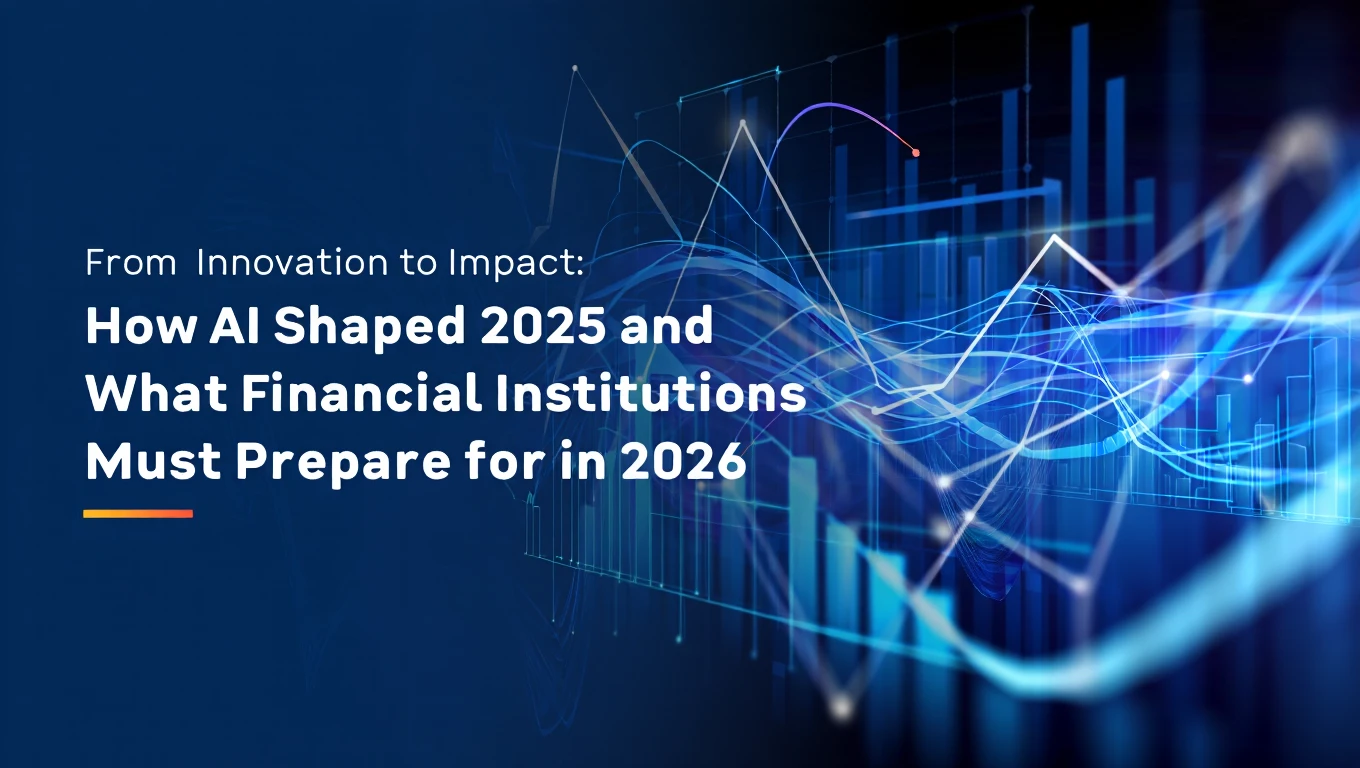
2025 was the year artificial intelligence finally grew up in the world of finance. It stopped being something banks and insurers played with in small experiments and became a real, everyday part of how things get done. From strategy and risk management to customer service. AI is now deeply integrated into the core operations and strategic framework of the financial services industry.
For anyone leading a financial institution, this changes everything. AI isn’t a “nice to have” anymore; it’s a must-have if you want to keep costs under control, stay on the right side of regulators, and give customers what they actually want. But with all the excitement comes responsibility. Regulators and the public expect AI to be fair, transparent, and carefully managed.
That’s where we come in at Intellecomm. We help banks, insurers, and investment firms turn their AI ideas into real results, safely and profitably. In this article, we’ll walk you through the biggest things that happened with AI in finance last year, the lessons we all learned, and a straightforward plan for making the most of it in 2026.
What We Learned from 2025
The Big Jump in Using AI
Last year, almost every part of finance started using AI seriously. Generative AI helped write reports, read contracts, and chat with customers. Machine learning got better at spotting fraud, predicting problems, and making operations smoother. The real game-changer? AI stopped being just about saving time on boring tasks. It started helping people make better decisions.
Many leading banks now have dashboards that show key risks like liquidity or market exposure in real time. What used to take days of spreadsheet work now takes minutes. That speed helps teams react faster when markets get bumpy.
Where AI Really Shone
The clearest wins came in three areas: Risk and Compliance, and customer relationships.
- Fraud detection and compliance tools got much smarter. Fewer false alarms, better accuracy, and the ability to spot issues early.
- On the customer side, banks and wealth managers started offering truly personal advice. Apps with built-in AI chat could answer questions in context, suggest the right products, and generally make people feel understood. Customers loved it – engagement and satisfaction went up noticeably.
One especially important trend was “explainable AI.” Regulators want to know how AI reaches its conclusions, so more firms have built tools that make decisions clear and easy to check. That made audits smoother and gave everyone more confidence.
Rules and Responsibility Came First
2025 wasn’t just about cool tech – it was also the year responsible AI became non-negotiable. Regulators in Canada, the EU, the US, and elsewhere made it clear: AI in finance has to be fair, transparent, and accountable.
Smart organizations built these rules into their AI from the start. They set up proper oversight, kept good records, and monitored systems ongoing. Those who did this could move faster and avoid headaches later.
Real, Measurable Results
When firms treated AI as a core part of their business – not a side project – the payoffs were clear:
- Insurers cut claims-processing costs by automating the first review steps.
- Investment firms made smarter trades using predictions.
- Banks freed up staff from routine back-office work so they could focus on customers and strategy.
The simple truth from 2025: AI works best when it’s aimed at clear business goals, fed good data, and managed properly.
How AI Changed Everyday Work in Finance
Planning and Oversight
Leaders could now run “what-if” scenarios instantly – testing how portfolios would perform in different economies or under new regulations. Many set up dedicated AI committees to keep everything on track.
Smarter Day-to-Day Processes
Combining AI with automation transformed routine jobs. Invoices, reconciliations, and payments – all faster and with fewer mistakes. Some banks cut back-office workloads by more than 40%, giving people time for more valuable work.
Better Data, Better Results
Everyone realized that great AI needs great data. Firms that cleaned up their data, connected silos, and tracked where information came from got much better outcomes – more accurate credit scores, sharper customer insights, lower churn.
Happier Customers
Personalized service became the biggest differentiator. AI helped deliver the right message at the right moment. Wealth apps started letting clients play with real-time financial scenarios, which built trust and stronger relationships.
The Bumps Along the Road in 2025
Not everything went smoothly. Many firms struggled with old systems, scattered data, and a shortage of AI-skilled people. Trying to bolt AI onto outdated tech often caused delays.
Bias in lending and credit models was a wake-up call for many. It showed that checking once isn’t enough; you need ongoing reviews and fixes.
And perhaps the biggest lesson: technology alone isn’t enough. People need to understand, trust, and embrace AI. Projects without strong leadership support or good change management usually stall.
Your Practical Roadmap for 2026
Here’s what I believe the next year will bring – and what you can do about it.
AI Becomes Normal Infrastructure
No more small pilots. AI will be built into core systems, helping with efficiency, compliance, and customers all at once.
Clear Explanations Will Be Standard
Every important AI tool will come with easy-to-understand explanations – because regulators expect it and it’s just good practice.
Real-Time Risk and Compliance Monitoring
Instead of checking things every quarter, AI will watch constantly and alert you the moment something looks off.
Truly Personal Customer Experiences
Offers and advice will feel tailor-made in real time, while still staying within all the rules.
AI Will Team Up with Other Tech
Combining AI with cloud, blockchain, and connected devices will create new possibilities – faster settlements, smarter insurance pricing, and more.
Investing in People
The smartest firms will train their teams broadly in AI basics. Internal knowledge will be key to keeping innovation going responsibly.
How Intellecomm Can Help
We partner with financial institutions to build AI strategies that actually deliver results – while keeping everything ethical and compliant. Whether you need a full roadmap, help with automation, stronger data setup, governance frameworks, or training for your leaders, we’re here for the whole journey.
2025 proved AI can transform finance. 2026 will reward the organizations that implement it thoughtfully and confidently. If you’re ready to make that happen, let’s talk.
Quick Answers to Common Questions
- How do you measure AI success in finance?
Look at real outcomes: lower costs, fewer risks, smoother compliance, and happier customers, not just how much tech you installed. - What was the most common mistake in 2025?
Keeping AI in small, separate experiments instead of making it part of the overall strategy and systems. - Why does explainable AI matter so much?
It builds trust, satisfies regulators, and lets you defend decisions when needed. - How do you reduce bias in AI?
Use diverse data, test regularly, monitor live performance, and have strict rules in place. - Will AI replace people in finance?
No. It makes people more effective by giving faster insights, but humans stay in charge and accountable. - What’s the best first step for 2026?
Get your data organized and your governance solid, and everything else builds on that.
Reference:
- AI in Financial Services 2025 by RGP → (Covers adoption acceleration, explainable AI, regulatory scrutiny, and embedding governance.)
- Artificial Intelligence: Use and Oversight in Financial Services by U.S. GAO (May 2025) → (Discusses AI in fraud detection, customer service, risk management, and regulatory oversight.)
- AI in Financial Services 2025: Transforming Risk, Fraud & Customer Experience by WDB Agency → https://www.wdb.agency/blog/ai-in-financial-services-2025-how-banks-insurers-fintechs-are-transforming-risk-fraud-customer-experience (Highlights fraud detection, compliance, personalization, and ethical challenges.)
- Explainable AI in Finance: Addressing the Needs of Diverse Stakeholders by CFA Institute (2025) → (Deep dive on XAI for transparency, compliance, and trust in financial decisions.)
Generative AI and Specific Use Cases
- Generative AI in Banking: 7 Real-World Use Cases (2025) → https://www.ideas2it.com/blogs/generative-ai-in-banking (Examples in personalization, fraud, and operational efficiency.)
- IBM 2025 Outlook for Banking and Financial Markets → https://newsroom.ibm.com/2025-02-05-ibm-study-gen-ai-will-elevate-financial-performance-of-banks-in-2025 (Rapid GenAI adoption and tactical implementations.)
2026 Predictions and Roadmap
- AI Transformation in Financial Services: 5 Predictors for Success in 2026 by Microsoft → https://www.microsoft.com/en-us/industry/blog/financial-services/2025/12/18/ai-transformation-in-financial-services-5-predictors-for-success-in-2026/ (Enterprise-scale AI, responsible frameworks, agentic AI, and convergence with other tech.)
- Predictions 2026: How Financial Services Can Thrive Amid AI Disruption by Forrester → https://www.forrester.com/blogs/predictions-2026-how-financial-services-can-thrive-amid-ai-disruption (Automation of processes, role-specific agents, hyper-personalization.)
- 2026 Predictions: The Year AI Reshapes Banking by Forbes Finance Council → https://www.forbes.com/councils/forbesfinancecouncil/2025/12/16/2026-predictions-the-year-ai-reshapes-banking-and-the-financial-system/ (Shift from pilots to production, data advantages, and talent focus.)